Dec 9
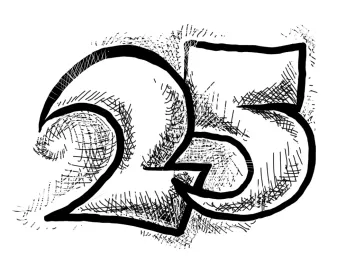
Transmissions at 25
Gwendolyn Ann Smith READ TIME: 4 MIN.
Twenty-five years ago, after what I presume was a strong showing on an op-ed in the Bay Area Reporter, I was asked if I would consider doing a regular column. I agreed, borrowing the name from a webzine I had been working on. With that, the first Transmissions column would premiere on November 2, 2000.
Since then, it has been my honor to produce this column. Some 650 essays so far, and counting. I’m sure my high school journalism teacher, Mrs. Karamitros, would be surprised – probably surprised about a few things, if I must be honest.
In that first piece, I did give a short biography. It all feels a world away now, of course. Organizations I’ve not been directly affiliated with for years, like that Web 1.0 startup that gobbled up the Web 1.0 startup, and was later gobbled up by another Web 1.0 startup – before going under, of course.
Back then, this thing called "transgender" was still largely unknown, or at least uncommon. Indeed, the word I used back then was "fringe." A lot of my focus was on educating people who weren't transgender, and helping to explain what is transgender.
That first column was about the ignorance and attitudes of politicians in my local community and at the federal level, as that year’s presidential election was coming to a close. That was the era of Bush v. Gore. It feels ever so quaint today.
Over 25 years, this has shifted. People are now somewhat familiar with transgender people and our needs, though there's still room for education. Meanwhile, what may have been a modern high-water mark for transgender people in 2014 or so has now developed into one of the worst backlashes since the 1930s.
This is the two-edged sword of visibility. You do not gain rights in the dark, but shining a light on you makes you a bigger target. I'd contend, having lived and written in times of light and darkness, well, neither is best, but I'd rather defend my rights as a transgender woman than live in the shadows.
In that first Transmissions column, I spoke about my early work on the Remembering Our Dead website, and the Transgender Day of Remembrance. This project continues and, in many ways, is far bigger than me, now.
Let me share a bit of a tangent. This will tie back together, I promise. Just give me a little rope here. You see, there is a C. Bechstein concert piano that was handmade in 1889 that has very much been on my mind while I reflect on the last couple of decades of my life.
In 1967, that piano was rented from a music shop in London called Jaques Samuel. It lived in Trident Studios in London. In 1969, The Beatles – tired of the four-track mixer at Abbey Road – gave Trident Studios a go. They did four takes on a new track. This is “Hey Jude.”
That same piano would be used on other Beatles tracks recorded at that studio, including “Honey Pie” and “Martha My Dear.” The studio would later bring in other performers to record there, including Badfinger and Billy Preston.
In 1970, a struggling musician named Elton John tickled those same ivories, recording “Your Song.” He'd later record most of the albums from his classic period. At this same time, David Bowie would be at Trident, recording all through the Ziggy Stardust era. That's the Bechstein on “Life on Mars,” for example.
Queen recorded there, as did Lou Reed, T. Rex, Carly Simon, Supertramp, and Harry Nilsson. Even Genesis – both with and without Peter Gabriel – recorded with that piano.
Each of the above played that C. Bechstein concert piano, and that piano added a characteristic sound to their songs. It is at the heart of dozens of hit records, and helped make some great musicians even better.
When I approach my own work to uplift the trans community, I have always sought to elevate. I don't feel the need to be the star of the show, but a part of a bigger picture. I approach us as a harmony of voices. I, too, am present in the mix, and I hope my tones add to it all.
I hope to be that piano, see – present and useful, but part of a much greater whole.
At the same time, I know that when I write the column, I am speaking with a somewhat singular voice. I can't not write from my own experiences and feelings, even as I do what I can to be objective in my views. If I see an injustice to those within the transgender community, I am going to understand how that injustice affects me – and, I hope, help you to see how it affects you, too.
Being trans means being a canary in a coal mine. The things that hurt us usually trickle down onto other groups, as so few seem willing to stand up when it is us being harmed. Likewise, misogyny, racism, and anti-immigrant actions, as well as bigotry against neurodivergence, disability, sex workers, and others often color what we as transgender people face.
I am absolutely going to speak out against such. It is my moral duty.
So, here's to 25 years of bleeding out onto the digital page. Here's to continuing to educate on trans issues, to explore what it means to be trans in this world, and to continue to agitate for a better world.
If I'm very lucky, perhaps there's a few more years to follow.
Gwen Smith is still standing. You'll find her at www.gwensmith.com